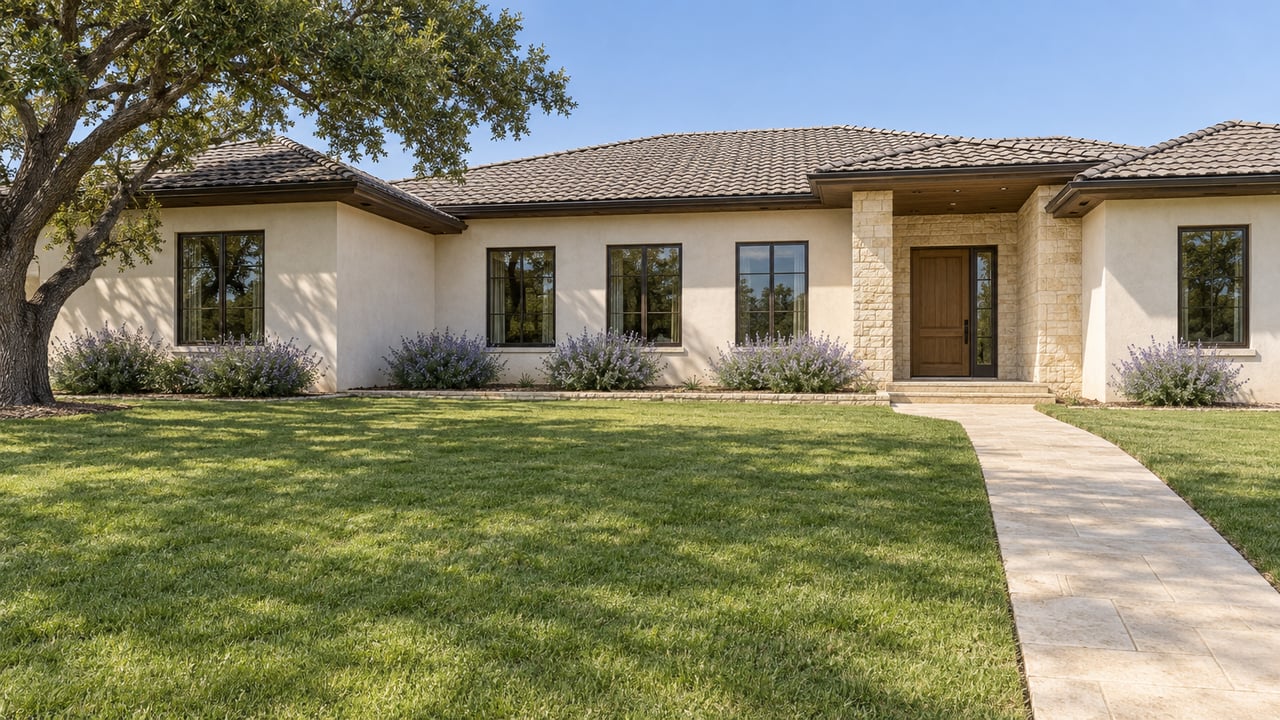
One Westlake Village Address, Two Water Bills: How The County Line Prices A Lot
October 15, 2026
October 15, 2026
"The first thing we screen for is where do you really live." That was Scott Wolfe, then planning director for the City of Westlake Village, speaking to The Acorn about calls to city hall. He estimated that 20 to 30 percent of callers weren't city residents at all. They lived in Thousand Oaks or a nearby community such as Lake Sherwood. That interview ran in 2011, and the confusion behind it hasn't gone anywhere. It now shows up on a monthly bill.
The water utility behind a Westlake Village address depends on which county the parcel sits in. The two main utilities price water on opposite principles. On the Los Angeles County side, Las Virgenes Municipal Water District sets each household's cheapest rate tier based on its own lot. On the Ventura County side, California Water Service uses the same fixed tiers for every single-family home, whatever the lot size. For a buyer comparing two estate properties a mile apart, the irrigated acreage and the elevation that help set the price also help set what it costs to keep the grounds green.
Westlake Village started in the 1960s as one of the country's first master-planned communities, and its land crossed the Los Angeles–Ventura County line. When the city incorporated in 1981, state law didn't allow one city to sit in two counties. The homes and businesses on the Ventura side became part of Thousand Oaks. The city's own FAQ page still draws the same distinction: the incorporated city is in Los Angeles County, and the Westlake Village section of Thousand Oaks is in Ventura County.
The line runs right through the area's best-known landmarks. The bridge to the island in Westlake Lake straddles it, with half in Westlake Village and half in Thousand Oaks. In that same 2011 Acorn report, Wolfe said North Ranch residents often assume they live in the City of Westlake Village when they actually live in Thousand Oaks. A 2023 letter and editor's note in the Thousand Oaks Acorn went over the same history again.
The postal name stayed the same on both sides of the line, but the utility arrangements didn't.
LVMWD gives every customer a water budget, and that budget sets where the cheap tier ends. According to the district's water budget page, the budget is built from three things. Each resident adds about 1.9 HCF a month, roughly 1,400 gallons. The irrigated area is estimated from aerial imagery and property records, and pools count toward it. A seasonal weather factor, ETo, makes the outdoor allowance bigger in summer and smaller in winter. Water used inside the budget is billed at the "Efficient" rate. Usage beyond it moves into the "Inefficient" and "Excessive" tiers.
Cal Water's tiers don't work that way. The Westlake tariff effective July 1, 2026 covers single-family homes in "Westlake Village, in the southern part of Ventura County, within the City of Thousand Oaks and vicinity." It sets four tiers by volume, and the breakpoints are the same for every home.
| 2026 residential pricing | LVMWD, City of Westlake Village side | Cal Water Westlake, Thousand Oaks side |
|---|---|---|
| How tiers are set | Per-household budget: residents, irrigated area, weather | Fixed volume breakpoints for every single-family home |
| Tier rates per unit | $4.56 Efficient, $7.68 Inefficient, $9.05 Excessive | $1.7799 for 1–6, $7.1075 for 7–25, $8.8982 for 26–44, $10.6674 above 44 |
| Elevation charge | $0.00 to $3.46 per unit by pumping zone | None in the residential tariff |
| Standard meter, monthly | $58.79 for ¾-inch | $57.53 for 5/8 x ¾-inch |
| 1-inch meter, monthly | $91.88 | $143.81 |
| Effective | January 1, 2026 | July 1, 2026 |
A unit is the same on both sides: 100 cubic feet, about 748 gallons. LVMWD calls it an HCF and Cal Water calls it a CCF. At small volumes the Cal Water side is cheaper, because its first six units cost under $1.78 each. At estate volumes the order flips. Every home on the Cal Water side reaches the $10.67 tier at the same point, whether it sits on a quarter acre or several acres.
Here's a simple illustration. It isn't a quote for any real property. It assumes a summer month at 50 units on a 1-inch meter, and it counts only water charges. LVMWD bills also carry sanitation charges, which this comparison leaves out.
The difference in the second scenario rests on the budget. On the LVMWD side, a large irrigated lot, a pool and a full household all make the budget bigger, so the same 50 units can stay in the cheapest tier. On the Cal Water side, the size of the lot doesn't move the breakpoints. A 50-unit month on a large property lands in the top tier, the same as it would anywhere else in the service area.
In the third scenario, elevation erases most of the advantage the budget gives a large lot on the LVMWD side.
LVMWD adds an elevation charge to every unit, depending on how high the water has to be pumped before it reaches the home. In 2026 it's $0.00 in Zone 1, $0.42 in Zone 2, $3.39 in Zone 3 and $3.46 in Zone 4. Zone 1 covers water that doesn't need pumping above a hydraulic gradient of 1,235 feet. Zone 3 covers 1,700 to 2,200 feet, and Zone 4 covers everything above 2,200. The district notes that most of its customers are in Zones 1 and 2.
At $3.39 a unit, a Zone 3 home pays 74 percent more per unit than the $4.56 Efficient rate before any tier change. That charge applies to every unit, indoors and out. The elevated sites that give a property its long views are often where pumping costs the most. The district publishes a billing zone map that shows where each parcel falls.
For equestrian and estate buyers on the LVMWD side, the budget can be changed. The district's adjustment request takes requests for a different permanent-resident count, medical needs, horses or livestock, licensed care facilities and changes to irrigated area. Medical requests need a physician's note. Livestock requests ask for the type and number of animals and may lead to a site visit. For a change in planted area, the form asks for a sketch or drawings showing total irrigated square footage and pool or spa surface area, leaving out the house and hardscape. Every adjustment goes through district review and takes effect when the district receives the request.
The budget on file is built from the resident count and irrigated area the district has recorded for the property. A buyer who brings horses, adds planting or moves in with a bigger household changes those inputs, and the form is how the district learns of it. Since the irrigated area starts from aerial imagery, a recently re-planted lot may be on file with outdated figures.
Being on the Ventura side doesn't automatically mean Cal Water. Cal Water describes its Westlake District as serving "a portion" of Thousand Oaks, and it brings in imported water through Calleguas Municipal Water District. Triunfo Water & Sanitation District is also in the area. In its FY2024-25 financial report, Triunfo says it provides drinking water to Oak Park and recycled water to Oak Park, North Ranch, Lake Sherwood and parts of Thousand Oaks. Triunfo's own drinking-water rates for a ¾-inch meter took effect July 1, 2026, with a $42.66 monthly service charge, $9.68 per unit for the first seven units, and $10.70 per unit above that.
None of these utilities publishes a street-by-street list of boundaries in text. Cal Water links a boundary map from its district page. The surest way to know which pricing system applies is the seller's recent bills or a call to the utility for that specific parcel.
LVMWD's current rates came out of a five-year plan approved in 2025 through the Proposition 218 process. The board reaffirms each year's adjustment before it takes effect. The district says efficient users will pay about $13 more per month each year through 2030. Part of that money goes to the Pure Water Project, which LVMWD expects to begin operating in 2028 and which is expected to eventually supply up to 30 percent of the community's drinking water. On the Ventura side, Cal Water's tariffs are approved by the California Public Utilities Commission. The company listed Westlake residential tariffs dated January 1 and July 1, 2026, which means rates changed twice this calendar year.
Does a Westlake Village mailing address mean the home is in the City of Westlake Village? No. The name covers both the incorporated city in Los Angeles County and the Westlake section of Thousand Oaks in Ventura County, and North Ranch is part of Thousand Oaks.
Can an LVMWD budget be increased for horses? The district accepts requests for horses or livestock. It asks for the type and number of animals and may visit the property. It decides each case individually.
Does Cal Water account for lot size? Its Westlake residential tariff sets the same volume tiers for every single-family home. The tariff text doesn't include a lot-size or occupancy budget.
When two estates in our area share a ZIP code but sit on different sides of the county line, we look at their water arrangements before we compare prices: who the provider is, which pumping zone the parcel is in, and what budget the seller has on file. If you're weighing acreage, a view lot or a horse property, Jaime Krupnick and her team can help you collect those details for each address. Request a Private Consultation.
This article is general information, not legal, tax or financial advice. Consult a qualified professional about your situation.
Stay up to date on the latest real estate trends.


From first conversation to closing day and beyond, Jaime delivers a true concierge experience. She guides clients through every step of buying and selling with clarity and confidence, backed by a trusted team of top-tier professionals. Her team can assist every step from staging and design to photography, inspections, contractors and lending, ensuring the process feels seamless, elevated and exceptionally well managed.
Jaime Krupnick | CA DRE# 02139605
[email protected]
(310) 749-0703
100 N Westlake Blvd Ste 100A
Westlake Village, CA 91362
Rodeo Realty, Inc. | CA DRE# 00951359